Belong Switzerland tracks your journey to citizenship
one requirement at a time.
Your tracker stays on the phone. No account, no tracking.
The same tracker, the same 418 questions, the same Swiss rules.
7 day free trialYour tracker stays on your phoneEvery rule dated and sourced

Android
There is no account and no tracking in Belong Switzerland. Here is exactly what that means on each phone.
The iOS app keeps your tracker on your iPhone. There is no account to create and nothing you enter leaves the device. The documents you attach are encrypted by iOS while the phone is locked and are deliberately kept out of your iPhone backup, so they never reach another device. Belong Switzerland never uploads them and never sees them.
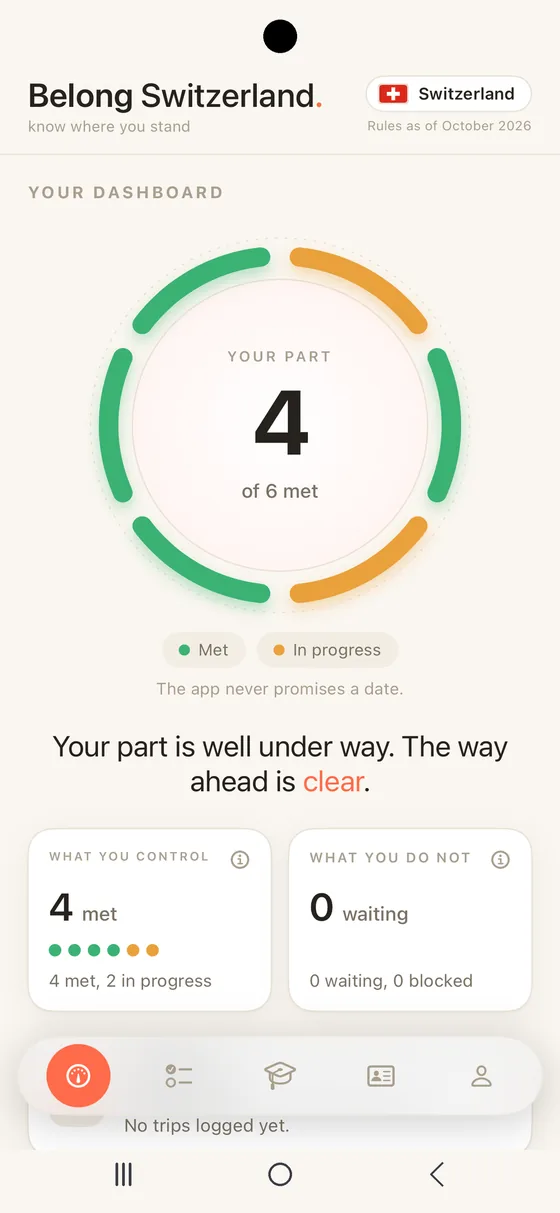
An Android app would keep to the same rule: your tracker stays on the phone, with no account and no tracking, and documents in the app's own private storage rather than anywhere we can reach. It is not on Google Play yet, so no listing there claiming to be it is ours. The Android screenshots on this page are the same app shown in a Galaxy's frame.
One tracker and the same promise on either phone: what you type in stays where you typed it.
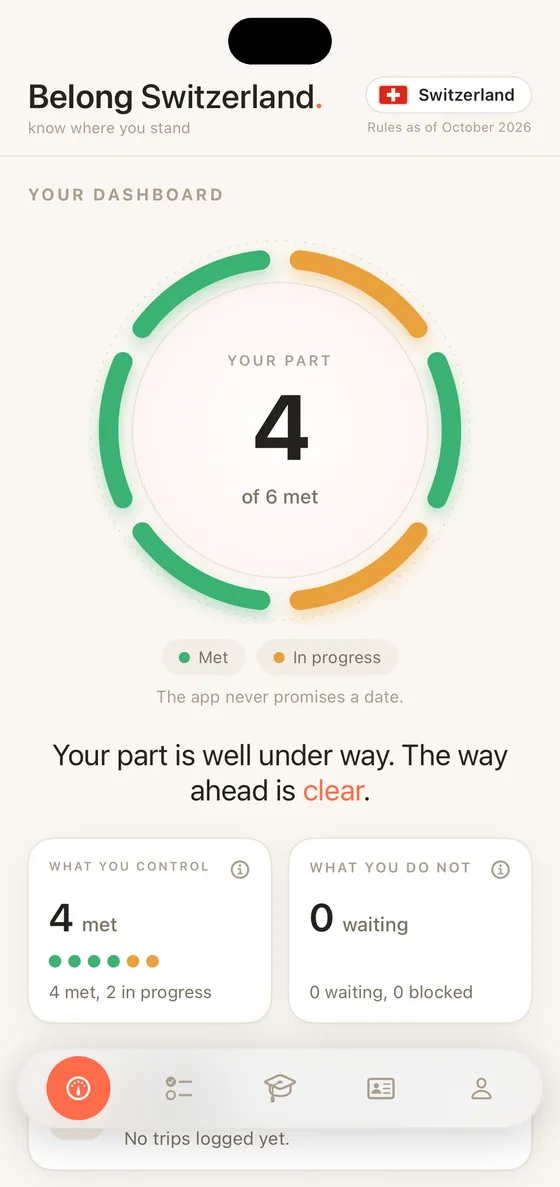
The Dashboard opens on a ring with one segment per requirement on your route: ten years in Switzerland, the C permit, a national language, knowledge of Switzerland, work or education and a clean record. Green is met, amber is in progress, red is blocked and the number in the middle is how many you have met. Every rule carries the month it was checked against the Citizenship Act and SEM.


The Dashboard splits the journey into the part you control and the part you do not. The ring shows how close you are, one segment per requirement, green when met, amber in progress, red when blocked. The number in the middle is how many you have met. Below it Belong Switzerland lists the routes open to you: ordinary naturalisation after ten years with a C permit, and simplified naturalisation for the husband or wife of a Swiss citizen, each carrying its own status. Switzerland lets you keep your current citizenship, so your route reaches a real finish line.
What's coming sits just under that split: the dates ahead of you, soonest first. The day your ten years are complete, the day after a trip ends, the day your B permit ends, a document about to expire. Every date says whether it is yours or the authority's, and one that is only a projection says so. Turn on alerts from the You tab and get a handful a year, with notice, never a feed. Every alert opens what it names.
The headline reads straight off the meter, so the words can never say more than the ring does, and when every requirement on your route is met the meter says so: your part is done. Standing sits on the Dashboard too, a card one tap from the meter it explains.
After you apply. Tell the app the day you filed and the Dashboard follows the wait with you: days since filing and SEM's page one tap away. Your commune, your canton and SEM each check the file, and no law sets how long the commune and the canton take, so there is no expected date, because none is published.
What if sits on the Dashboard and answers that without touching your file. Flip the national language or your knowledge of Switzerland to passed, add a C permit, spend months abroad and watch your finish line move under the real Swiss rules. It runs on a copy of your situation, so nothing you try is saved and nothing you entered changes.
Ordinary naturalisation asks for a settlement permit, the C permit, on the day you apply. A B permit is not enough, however long you have held it. So Path opens in two stages, and for most people stage one is where it starts: the requirements of the C permit under article 34 of the Foreign Nationals and Integration Act, with your years counted and the rest to tick off.
Ten years on an L or B permit, the last five unbroken on a B permit, the local national language at A2 spoken and A1 written, work or education and respect for public safety and order. Underneath sit the five year routes: citizens of the EU and EFTA states with a settlement agreement, the early C permit for the well integrated and the husband or wife of a Swiss citizen or of a C holder.
Never miss a permit extension. Add the day your B permit ends and the Dashboard counts down to it. The law accepts your request from three months before and asks for it at the latest 14 days before. A permit that is not extended lapses on the day it ends, and a gap can break the unbroken years on a B permit that the C permit asks for. The reminder comes in time to book.
Stage two of Path lays out every requirement for citizenship in order. A green tick is met and a coral dot is in progress: ten years in Switzerland with three of them in the five years before you apply, the C permit, a national language at B1 spoken and A2 written, knowledge of Switzerland, work or education and respect for public safety and order. Each item explains the rule in plain language and links to the official text, the Citizenship Act or the Citizenship Ordinance on fedlex.
What the app does not model, it says plainly. Years lived here between your 8th and 18th birthday count double. Time on an F permit counts at half. Your canton adds two to five years of its own in the canton, and many communes add time there too. The ten years keep counting when you move, but those cantonal years can start again.
Every requirement can carry the evidence for it: a language certificate, a residence permit, a payslip, an extract from the criminal record. Note when a document expires and that date joins What's coming a month ahead, so a certificate never lapses quietly while you are waiting. Documents stay on the phone you added them on, encrypted by iOS while it is locked and kept out of the backup, so a restored phone will not bring them back. Keep your own copy of anything hard to replace. Belong Switzerland never uploads them and never sees them.
Switzerland has no national citizenship test. The Citizenship Ordinance asks for basic knowledge of the country's geography, history, politics and society, and lets each canton decide whether and how to check it: a written test, an interview or both, and some cantons ask for it before you apply.
So the 418 practice questions cover those four areas, in the ordinance's order, each chapter showing how much you hold. Most cantonal tests are in German, so the questions are in Swiss Standard German with an English line under each. Your canton's own questions about the canton and the commune are listed as a chapter of their own and greyed out, with a pointer to where your canton publishes its material, rather than filled in with guesses.
Today's five is about a minute a day: what you get wrong comes back sooner, what you know comes back later. Chapter drills and a mistakes deck sit beside it. Set a daily reminder and it quotes one of the questions waiting for you, and once today's five are done, tonight's reminder is withdrawn.
The guides, offline. Five guides to the Swiss rules sit inside the app as a Guides segment, each dated to the day its facts were checked, readable on a plane with no connection at all. Practice, Chapters, Progress, News and Guides share one tab, a segment apart.
Standing watches the moving ground, your time abroad and your record. Under the Citizenship Act, actually living abroad for more than six months, or deregistering, counts as giving up your residence in Switzerland. So Belong Switzerland measures your longest single stay against that six month line and tells you honestly when a trip could break your count. Up to a year abroad for your employer or for education still counts as a short absence, and the app names that exception rather than guessing it.
Your record sits here too, with a plain read of the lines the Citizenship Ordinance draws: an unconditional sentence, a measure, a ban or an expulsion rules naturalisation out while it shows in the criminal record, and so does a suspended sentence over 90 day-fines or three months. Other entries are weighed case by case.
Plan a trip before you book. Add a trip dated ahead and the trip sheet shows what the days away would do against the six month line, on a copy of the real rules. Planned trips sit in their own group, marked as planned, and count for nothing until they have happened. The day after a trip ends, What's coming asks whether the dates held.
Passport is the reason for all the rest: the document your road leads to. Pass 22 as it is, the real cover in colour, with the facts that matter beside it: validity, fee, where to apply and dual citizenship. Every figure is taken from ch.ch, dated and linked to the source.
Add your name and a photo on the You tab and the passport carries them as the holder's. A pill under the cover says when you could apply, at the earliest, from the same figures your Dashboard reads, and the tab tells you what makes this passport particular: its pages travel through all 26 cantons, each shown by its mountains and waterways, water is the theme from Pizzo Rotondo in the Gotthard massif onward and one page belongs to the Swiss abroad. Valid ten years for adults and five before 18, CHF 140 for adults and CHF 60 under 18 plus CHF 5 postage, ordered online or at your cantonal passport office and then collected in person. Switzerland has allowed dual citizenship since 1992.
News by The Local Switzerland. The immigration and citizenship news that actually affects your path, from The Local Switzerland, the English-language news site for Switzerland, inside the app. Two of their feeds, immigration and Swiss citizenship, merged and newest first, so the story that changes your case is one tap away and opens without leaving the app. Turn on news alerts on the You tab and the app checks in the background and sends one quiet notification when something new is published. A widget shows the newest story on your home screen or Lock Screen.
Some of that news is about the rules themselves. The Demokratie-Initiative, for example, asks for a right to naturalise after five years; the Federal Council and both chambers of Parliament have said no, and nothing changes unless the people and the cantons accept it at a vote. The Dashboard's outlook says where such a proposal stands, and until the law changes the ten years apply.
You is where every number comes from. Set the month you came to live in Switzerland and a short list of honest toggles: your C permit, marriage to a Swiss citizen, the national language, your knowledge of Switzerland and work or education. Change one and the Dashboard updates right away. Your name lives here too, and a photo of you, and the Passport tab carries them as the holder's; both stay on the phone. The legal disclaimer closes the tab, because Belong Switzerland tracks the rules but does not give legal advice.
On your home screen. Four iPhone widgets, for the home screen and the Lock Screen: where you stand, your longest stay abroad against the six month line, whether today's five is done and the newest story from The Local Switzerland. The same numbers the app shows, run through the same rules, and nothing leaves your iPhone.
A second person on the same iPhone. Add your partner, or another adult, under Household and they get their own count, with their route, their years and their trips. Switch between you from the same card, and the header says whose count is on screen. A trip you took together is logged once and counted for both of you. Everything about the second person stays on the phone, like everything else here.
Tell a friend. Know someone on the same road? A card on the You tab sends Belong Switzerland to them in two taps, with a short message and a link to this site. Nothing about you is sent.
Ten years in Switzerland for ordinary naturalisation, three of them in the five years before you apply, and a C permit on the day you apply. Years lived here between your 8th and 18th birthday count double, with at least six actually lived here. Your canton adds two to five years of its own.
For ordinary naturalisation, yes. A B permit is not enough, however long you have held it. The husband or wife of a Swiss citizen applies through simplified naturalisation, which needs no C permit.
There is no national test. The Citizenship Ordinance asks for basic knowledge of Swiss geography, history, politics and society, and your canton decides how to check it: a written test, an interview or both.
B1 spoken and A2 written in German, French, Italian or Romansh, shown by a recognised certificate or by your schooling in that language.
Living abroad for more than six months, or deregistering, counts as giving up your residence in Switzerland. Up to a year abroad for your employer or for education still counts as a short absence.
Switzerland has allowed dual citizenship since 1992. Whether your other country lets you keep yours is decided by its own law.
Yes. Simplified naturalisation asks for five years in Switzerland, including the year before you apply, and three years of marriage and living together. SEM decides, not your canton.
Your commune, your canton and SEM each check your file, and no law sets how long the commune and the canton may take. SEM decides on the federal permit within eight months as a rule, and the canton then decides within a year.
From the Citizenship Act and the Citizenship Ordinance on fedlex.admin.ch and SEM, checked on 30 September 2026. Not legal advice: your canton's naturalisation office decides your case.
Belong Switzerland is coming very soon to the App Store. Write to us and we tell you the day it is out.
7 day free trialOne yearly priceNothing leaves your phone